The Column Auditions
Twelve hologram hosts try out for one interactive dome
Context
Within Our Reach is an interactive dome: a projection column in the middle of the room, ringed by screens on plinths, with a forest panorama around the walls. The column needed a host, an AI helper that visitors meet in the middle of the room. Before anyone models or animates a character, someone has to decide who it is.
The challenge
Comparing characters fairly. If the room, the camera and the light change from one image to the next, you end up judging the render instead of the character. Every candidate had to stand on the same spot, in the same room, seen from the same seat.
How it was built
One reference image, my own render of the dome interior, edited in ComfyUI with Flux.2 Klein 9B, Qwen3 8B as the text encoder, 12 steps and no LoRAs. The prompt is a single sentence: "a surreal AI helper hovers in the center of the column." The room, the screens and the camera all come from my render. Between candidates I changed a word or two, and the seed. That session produced far more than twelve. I reviewed every one, edited and art-directed the strongest by hand, and weeded out the slop until these were left.
The casting sheet
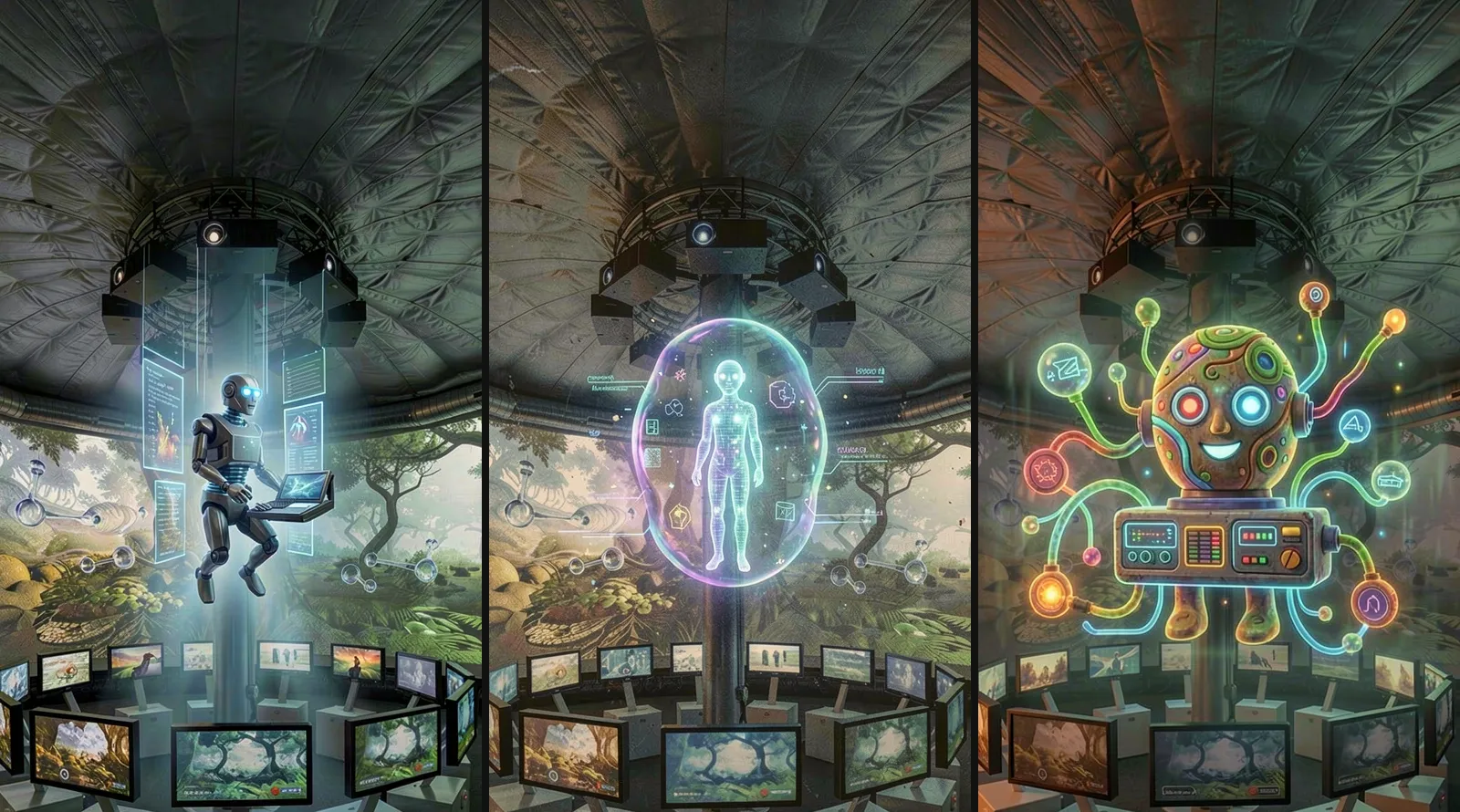
The twelve that survived review, cropped to the column, in the order they were made. Under each: the words that changed from the one before. Tap one for the full room.
The prompt, with the words I swapped:a [surreal / retro, organic, genderless / retro, organic, quirky] AI helper [(nothing) / hologram / holographic image] hovers in the center of the column
What surprised meOne word did most of the work. Without "hologram", the helper came back as a solid robot sitting at a laptop. Add it and the character turned to light, and the model relit the whole dome to match.
What the words did
"Genderless" gave the calmest, most neutral figures: plain outlines, one sealed in a bubble. "Retro, organic, quirky" brought out faces, cables and colour. Asking for a "holographic image" instead of a hologram sometimes put the character back inside a framed screen, which is the opposite of what a column of light is for.
Outcome
Twelve candidates worth discussing, side by side in the same room. Generating is fast; choosing is the work. That's a casting conversation a client can have before anyone commits to modelling, rigging or voicing a character.
Why it belongs here
Character design comes before character building. This is the cheap first step: find out who the host is, then build them for real, as a real-time avatar that can talk back.